
News and Events
 Neurotalks: the upcoming neuroscience talks in Göttingen [more]
- Currently we do not have open positions [more]
- Licht geht ins Ohr [more]
- Volles Haus zum „Tag der Sinne“ [more]
- Tobias Moser ist Falling Walls Life Sciences Gewinner 2022 [more]
- Land Niedersachsen fördert die vorklinische Entwicklung des optischen Cochlea Implantats [more]
- Restoring Hearing With Beams Of Light [more]
- Wissen erkennt – Nacht des Wissens an der UMG [more]
- Europäische Spitzenförderung zur Erforschung des Hörens [more]
- Tierversuche an Affen: Diskussion zum Tag des Versuchstiers [more]
- Gutes Hören ist wichtig für die Lebensqualität [more]
- It´s the rhythm that counts [more]
- Pathway-selective optogenetics reveals the functional anatomy of top–down attentional modulation in the macaque visual cortex. [more]
- Probing the role of the C2F domain of otoferlin. [more]
- Ca2+-binding to the C2E domain of otoferlin is required for hair cell exocytosis and hearing. [more]
- Effect of attention on human direction-discrimination thresholds at iso-eccentric locations in the visual field: A registered report protocol. [more]
- Ca2+ regulation of glutamate release from inner hair cells of hearing mice. [more]
- FGFR1 variants contributed to families with tooth agenesis. [more]
- Diversity matters - extending sound intensity coding by inner hair cells via heterogeneous synapses. [more]
- Fibroblast growth factor 9 (FGF9)-mediated neurodegeneration: Implications for progressive multiple sclerosis? [more]
- Piccolino is required for ribbon architecture at cochlear inner hair cell synapses and for hearing. [more]
- Synaptic activity is not required for establishing heterogeneity of inner hair cell ribbon synapses. [more]
- Unraveling haplotype errors in the DFNA33 locus. [more]
- Age-dependent structural reorganization of utricular ribbon synapses. [more]
Jobs
Press releases
Publications
Photo Gallery






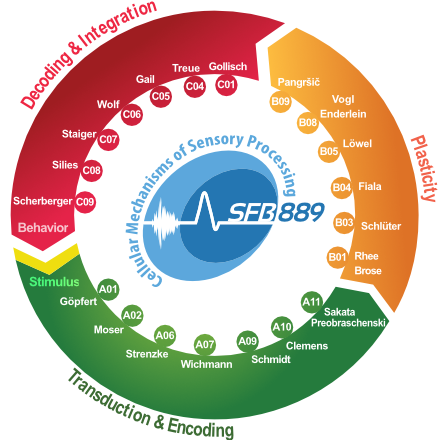
The interdisciplinary Collaborative Research Center 889 “Cellular Mechanisms of Sensory Processing” was established by the German Research Foundation (Deutsche Forschungsgemeinschaft, DFG), took effect beginning January 1st, 2011, and was prolonged for another four years beginning January 1st, 2019.
Summary of SFB 889:
Processing of sensory information is the basis of our interaction with the outside world and sensory deficits remain a major concern and serious burden for public health. This CRC will take a multidisciplinary and integrative approach to elucidate cellular mechanisms of processing sensory information. Sensory cells and neurons feature specialized signaling machinery achieving remarkable performance, which when disturbed result in sensory dysfunction. We will study sensory transduction, synaptic transmission, neuronal plasticity and the function of neuronal networks from the level of protein complexes to behavior. Combining molecular perturbations with analysis of morphology and function of sensory systems and mathematical modeling, we will contribute to a comprehensive understanding of sensory processing and its disorders. Working on flies, rodents and primates and comparing audition, vision, olfaction and somatosensation we will explore common principles and decipher specialized mechanisms of sensory processing. Intensifying pre-existing and initiating collaborations among scientists from various university and non-university institutions is key to accomplishing our ambitious research plan.
Goals of the SFB 889 are:
- Characterization of the specialized supramolecular machinery of sensory transduction and synaptic transmission
- Unravelling of mechanisms of neuronal plasticity in sensory systems
- An improved understanding of integration and representation of sensory information in the CNS
- To contribute to an improved understanding of sensory deficits and the development of therapeutic approaches



